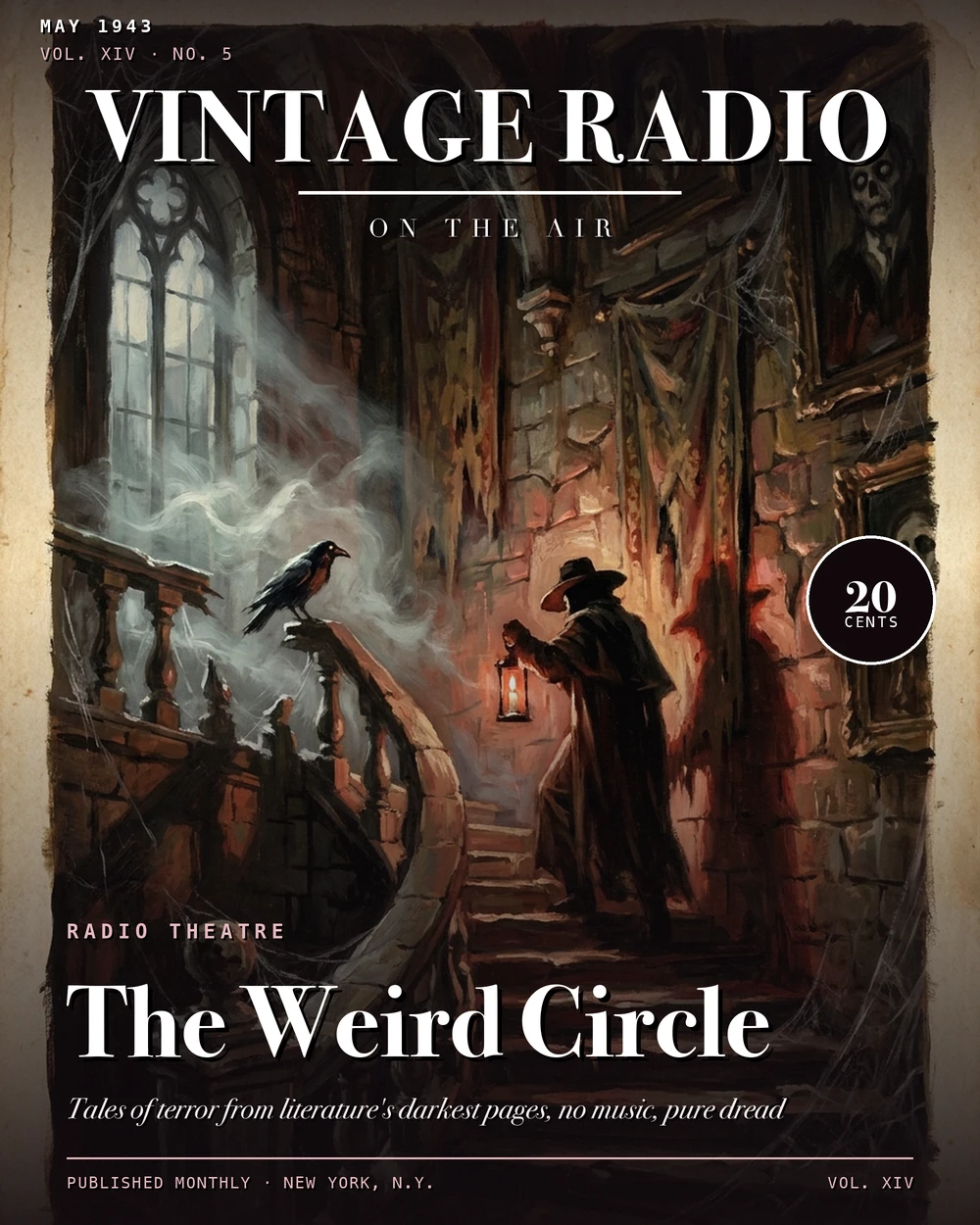
The Weird Circle
The Invitation That Started It All
Every episode of The Weird Circle began the same way, with a voice intoning from what sounded like the edge of the world: "In this cave by the restless sea, we are met to call from out of past, stories strange and weird. Bell keeper, toll the bell, so that all may know that we are gathered again in The Weird Circle." That opening set the tone perfectly — solemn, theatrical, a little gothic — and it made a promise the show consistently kept. For two seasons between 1943 and 1945, The Weird Circle delivered dramatizations of classic horror and mystery fiction, drawing from some of the most durable source material in the English language.
The show premiered on August 29, 1943, with an adaptation of Edgar Allan Poe's "The Fall of the House of Usher," which was about as clear a statement of intent as a series could make. Poe would remain a central source throughout the run, with episodes like "The Cask of Amontillado" and "The Case of Monsieur Valdermar" joining the catalog alongside works drawn from Robert Louis Stevenson, Charles Dickens, Victor Hugo, Guy de Maupassant, Hans Christian Andersen, Nathaniel Hawthorne, Honoré de Balzac, and Emily Brontë. The show had found a niche that none of its contemporaries were quite filling: a horror anthology built entirely on the literary past.
How It Got Made and How It Spread
The Weird Circle was a syndicated production, and understanding what that meant in 1943 helps explain why the show looked and sounded the way it did. Production was handled either by the Frederic W. Ziv Company or by NBC's Radio Recording Division — sources disagree on this, and the show's complex production and distribution history makes a clean attribution difficult. What's clear is that it was recorded at RCA's New York studios and licensed through the Mutual Broadcasting System, later moving to NBC's Red network.
Syndication meant the show didn't go out over a single national feed to a fixed audience on a fixed night. Instead, it was sold station by station. The first 26 episodes hit the market in 1943 and were picked up by around 40 stations in the United States and Canada. By January 1944, trade publications were announcing 13 new episodes, bringing the total to 39 and the station count to 65 American outlets and 34 Canadian ones. By mid-1944, the show had grown to 52 episodes and was running on 82 stations. Two more batches of 13 episodes followed — one in August 1944, one in the spring of 1945 — bringing the final count to exactly 78 episodes across two seasons of 39 shows each.
That growth pattern is telling. The show wasn't a prestige network production with a guaranteed prime-time slot. It built its audience the slower, harder way, station by station, and the fact that it kept expanding suggests it was earning its keep at those 80-plus outlets. The Haunting Hour, a later syndicated horror series, was reportedly inspired by Ziv's success with The Weird Circle, which gives some measure of the show's influence within the genre. After its initial run, RCA continued offering the series for sale to individual stations into the early 1960s, and Charles Michelson handled distribution throughout the 1960s and 1970s. The series was still being offered to stations as late as 1961.
The Sound of It
The most unusual production choice The Weird Circle made was also its most defining one: the show used almost no background music. Where contemporaries like Suspense, Inner Sanctum, and Lights Out leaned on orchestral scoring to build atmosphere and signal emotional turns, The Weird Circle stripped all of that away. The only musical element was the occasional piano chord marking a scene transition. Everything else was voice, sound effects, and silence.
This wasn't necessarily a prestige decision. The show was produced on a modest budget, without recognizable star voices, drawing from the general pool of New York City radio talent. Known cast members include Lawson Zerbe, Gladys Thornton, Walter Vaughn, and Arnold Moss — skilled radio performers, but not the household names that anchored the bigger network anthologies. The stripped-down approach may have been as much a budget reality as an artistic choice. But the effect it produced was distinctive. Without music to cue the audience's emotions, the writing and performance had to do that work alone, and the show's reliance on well-worn literary source material gave it a foundation solid enough to hold up.
The absence of musical accompaniment has also kept the series from sounding as dated as some of its contemporaries. Music ages. A piano chord between scenes doesn't.
What It Adapted and How
The literary source material was all in the public domain — 19th-century works, and occasionally older — which kept the rights situation simple and gave the writers an enormous catalog to draw from. The adaptation approach varied by the length and nature of the source. Longer works got heavily abridged, sometimes drastically so to fit a 30-minute format. Shorter works went the other direction: they were expanded, padded out with additional characters, and sometimes given romantic subplots that weren't in the original text.
The results were uneven, as you'd expect. Compressing a novel like Frankenstein into 30 minutes, or stretching a Poe short story to fill the same slot, required the kind of creative compromise that doesn't always serve the source. But the catalog's breadth is impressive. Beyond the Poe and Stevenson standards, the series dramatized Hugo's "Last Days of a Condemned Man," works by de Maupassant and Hawthorne and Brontë, and titles like "The Man Without a Country," "Dr. Jekyll and Mr. Hyde," and "Bride of Death." Episode titles like "A Rope of Hair," "Curse of the Mantle," and "Falkland" suggest the show was willing to go to some darker and more obscure corners of the literary tradition, not just the well-known chestnuts.
The Record It Left Behind
All 78 episodes survive, and they're reported to be in excellent condition — an unusually good preservation record for a syndicated show from this era. Radio Spirits produced commercial releases of the series, with liner notes by Karl Schadow, and the catalog was certified in 2013 with an updated certification issued in April 2020. That work gives the surviving recordings a well-documented provenance, which is more than many shows from the period can claim.
The Weird Circle has maintained a following among old-time radio enthusiasts, and the reasons aren't hard to understand. It occupied a specific and largely uncontested position in the wartime radio landscape: a horror anthology devoted entirely to literary adaptations, produced with minimal frills, running on dozens of stations simultaneously without ever becoming a nationally recognized institution. It wasn't trying to be Suspense. It was doing something narrower and in some ways more honest — taking stories that had already proven themselves on the page and seeing what they could become with a cast of voices, a microphone, and almost no music at all.